Every writer who has tried to adapt a big book knows the moment. You have four hundred pages of a world in front of you, all of it good, and roughly a hundred and ten pages of screenplay to hold it. The math is not close. Something enormous has to go.
With A Dweller on Two Planets, the math was worse than usual. My first complete draft ran past 160 pages. I knew it was long while I was writing it. I kept going anyway, because I wanted to see the whole thing standing up once before I started taking it apart.
Cutting it taught me more than writing it did.
What went first was not what I expected. I assumed I would lose action. I lost explanation. Whole passages I loved, where the book patiently tells you how a thing works and why the society is arranged the way it is, came out in a single pass. Every one of them was interesting. Not one of them was a scene.
That is the lesson, and it applies to any world you build, whether it sits twelve thousand years behind us or twenty years ahead.
The audience does not want your world. They want a person in it.
This is the trap, and big fantasy walks into it constantly. You have designed something remarkable. Towers, ships, a social order, technology nobody has seen. Every instinct says show it. So the film opens on a slow reveal of the capital, a voice explains the history, and for four minutes the audience is a tourist.
Tourists do not lean forward. They look.
The rule I work by now is short. The world only exists when it costs somebody something.
Not when you display it. When it presses. A flying craft is a beautiful image and an empty one until the man on board is being carried somewhere he cannot come back from. A law is set dressing until it stands between a character and the only future he wants. A temple is production design until somebody kneels in it and lies.
Atlantis in this novel is thick with machinery, and Oliver describes all of it with the casual confidence of a man writing about household appliances. Flying craft. Voices carried without wires. Energy pulled from sources nobody in 1880 could name. On the page it is astonishing. On screen almost none of it can arrive as astonishment. It has to arrive as pressure.
Zailm is a miner's son. That is the whole engine. Everything Atlantis can do, it can do for him or to him, and the film only works if the audience feels both at the same time.
The second thing the cutting taught me: research is for what you leave out.
I read the Atlantis literature more or less completely while I worked on this. Ignatius Donnelly, who got the Victorian world to take the subject seriously. Edgar Cayce's readings. The modern researchers, the sober ones and the ones considerably less sober. I was not looking for proof of anything. I was looking for enough texture to build a place that behaves consistently when the camera is not explaining it.
Almost none of it reaches the screen directly. That was never the point. An audience can feel the difference between a world invented for the scene in front of them and a world that existed before the scene started. They cannot tell you what the difference is. They feel it in whether the actors seem to live there.
You do the reading so you can throw it away with authority.
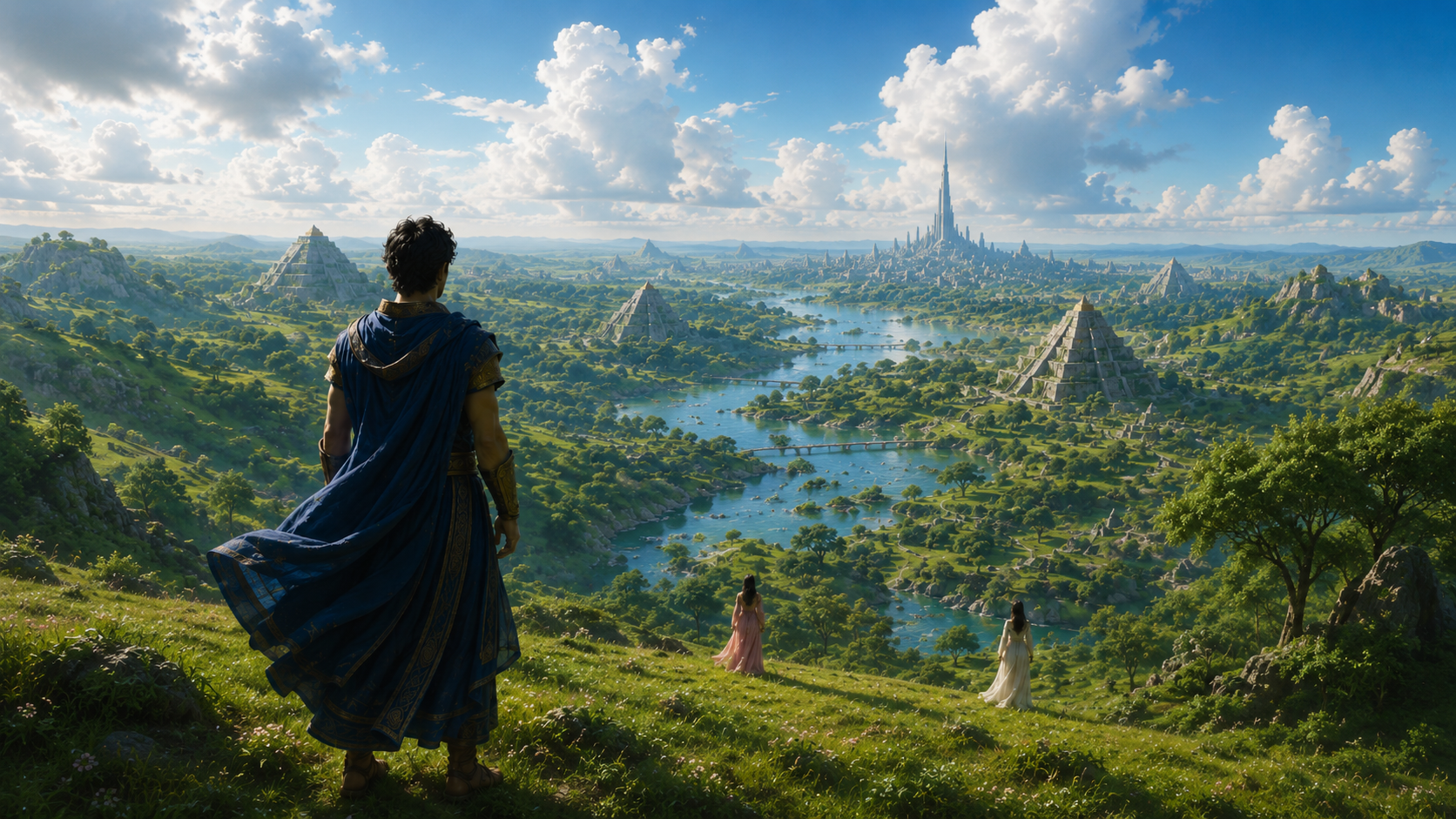
Third, and this is where the film started to become visible to me. The first piece of key art we developed says almost nothing about Atlantis.
A young man stands on a high overlook, seen from behind. Below him, a green valley, a pyramid, the capital in the distance with one slender tower. Two women stand apart from each other on the rise. That is the entire image.
There is a practical reason he faces away. The project is not cast, and I am not putting a face on this character before an actor earns it. But the practical reason turned out to be the right creative one. The image is not about Atlantis. It is about a man looking at everything he wants and not yet knowing what it will take from him.
The two figures come straight from the book's own language. Oliver describes them as a blush rose and a white lily. We put that into the art before we put a single machine into it, because underneath the philosophy and the technology, this is a love story, and a tragic one. The novel's subtitle is The Dividing of the Way. It is not talking about a continent.
So the working order for this adaptation is set, and it runs against everything the material invites you to do.
Man first. Choice second. World third, and only where the world is applying force.
That is not modesty about the spectacle. The spectacle is coming, and it should be overwhelming, because a civilization at the height of its power ought to look like the height of its power. But scale is not meaning. A city is a lot of buildings until somebody can lose it.
I have written elsewhere about the book itself, how it came to me and why it took five readings to get through. This is the other half of that story. What happens after you fall in love with a book and then have to be ruthless with it.
The novel asks what becomes of a civilization when its technological power advances faster than its wisdom. That question does not need Atlantis to land. Atlantis gives it twelve thousand years of distance, which is sometimes the only way an audience will let a question like that get near them.
The work now is the work it always is. Make it move. Make somebody want something badly. Let the world do the hurting.